Environmental Impact
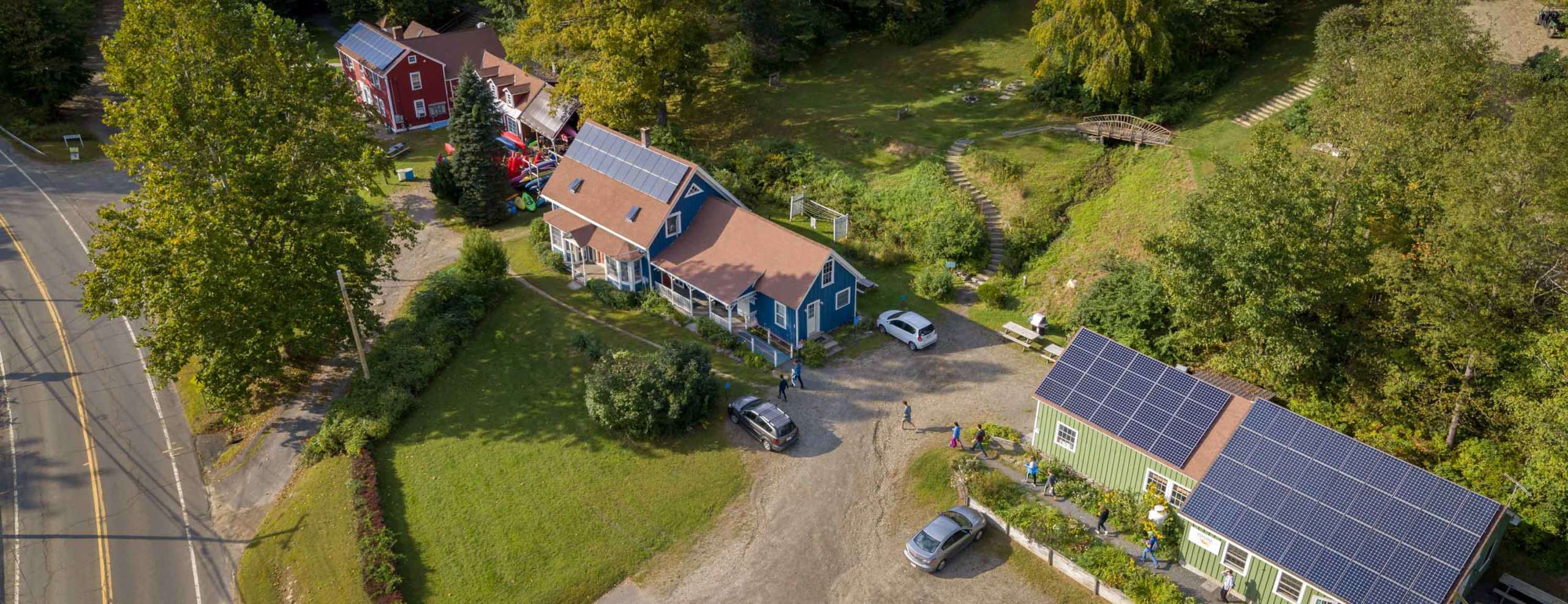
Solar Power – A New Twist on an Old Idea
When Moses Rice built the house where Zoar Outdoor is based in 1743, he had the pick of lots in town (his was the first house). Charlemont was a rugged frontier at the time and to survive you had to conserve your resources and take advantage of every benefit the environment offered. It’s no surprise then, that he oriented the house almost directly toward the south in an open part of the river valley.
This southern aspect allowed him to benefit from the warmth of the sun whenever possible. Every bit of solar heat he could utilize was another piece of wood he didn’t have to cut and haul to his fireplace.


263 Years Later
In the 21st century, we’ve overcome most of the daily struggles that made life difficult for the Rice family so long ago, but it still makes good sense to use our resources carefully. The sun that warmed the house in Moses Rice’s day provides electric power to Zoar Outdoor today.
In the fall of 2006, we hired Pioneer Valley Photovoltaics to install solar panels on the roofs of our three south-facing buildings along Route 2 for a total generating capacity of 15 kilowatts. In 2009 we added another 10 kilowatts to our capacity. Our 25 kilowatts of total production capacity provides about 90 percent of the electricity needs of Hawk Mountain Lodge and 40 to 50 percent of the electricity needs of our main base, where we have a commercial kitchen with several refrigerators, a network of 10 computers and our offices and retail store.
The system we installed was made possible by a grant from the Mass Technology Collaborative which is funded by the renewable energy surcharge all Mass residents pay on their electric bills. The grant paid about a third of the total cost of the project, with a bank loan financing the rest. We’re expecting a payback period of 10 to 12 years.
In 2011 we added another 11 kilowatts of photovoltaics to the roof of our zip line canopy tour base, bringing our total production up to 25 kw and offsetting about 80% of our total electricity usage.
One of our core values is that
We value thoughtful planning so we are able to maximize our resources, minimize our environmental impact, and balance the excitement of new possibilities with the need to maintain quality and continuity.
Our decision to go solar was driven by our conviction that maximizing our resources and minimizing our environmental impact should be no less important now than they were in 1743. By producing our own power using the sun, we expect to avoid emissions of 59 lbs. of Sulphur Dioxide annually, 19 lbs. of Nitrogen Oxides annually and over 16 tons of Carbon Dioxide annually.
Moses Rice knew that if he didn’t plan carefully and conserve his energy, he wouldn’t last on the frontier. Our business is built on the wise use of our rivers, mountains, and trails. Preserving these natural areas is a matter of making smart decisions now about how much energy we use and how we produce that energy. We’re proud to be powering our own adventures!
Some Interesting Facts About Solar Power
- After the first 18-36 months of operation (the actual time period depends on the type of modules and the system specs) a PV system has produced as much energy as was used in its manufacture, including the framing and mounting. (National Renewable Energy Laboratory, 2005)
- Taking into account the fossil-fuel-based energy used in their manufacture, 87-97% of the energy PV systems generate won’t be plagued by pollution, greenhouse gases, and depletion of resources. (David Brainbridge US College of International Business)
- A typical US household consumes about 900 kWh of electricity per month.
- Compared to coal-generated electricity (50% of the electricity in the US) a PV system designed to generate 1,000 kWh of electricity per month will reduce carbon dioxide emissions by about 1,400 pounds, reduce sulfur dioxide emissions by 8 pounds, and nitrous oxide emissions by 5 pounds per month.